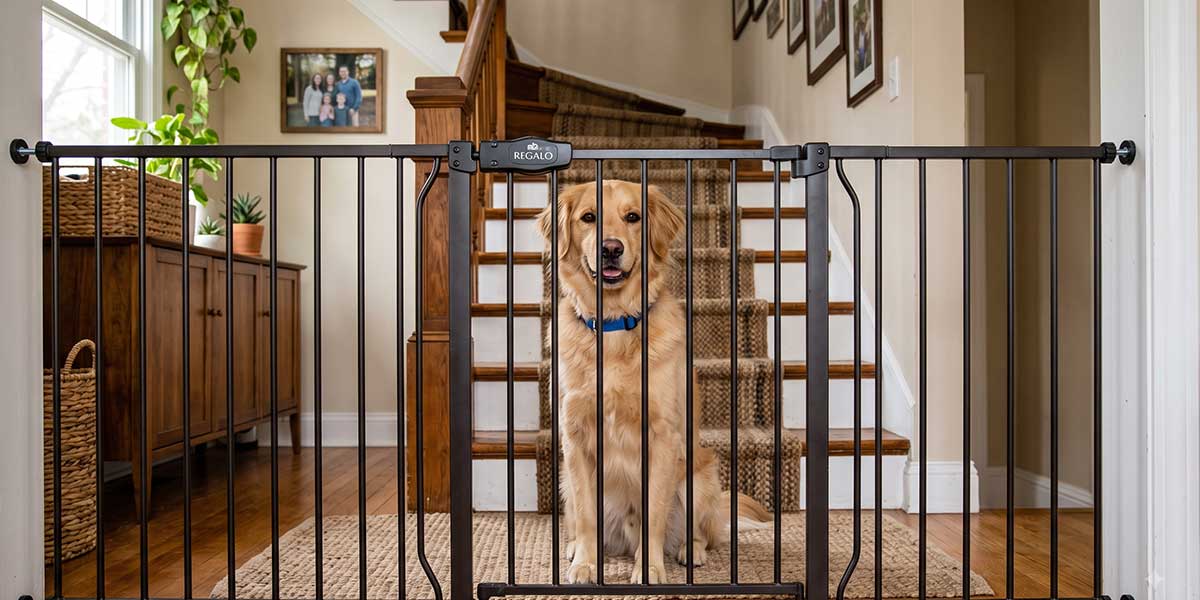
Rebuilt with the real ASTM/CPSC mount-type safety standard and 6 verified current picks
Ask around and most people assume any “stair gate” is safe wherever you put it. That’s not quite right. Pressure-mounted gates rely on friction, and a hard enough push — from a determined dog, a person tripping into it, or just years of use loosening the fit — can dislodge one. At the top of a staircase, that’s a real fall risk, not a hypothetical. At the bottom of stairs or in a doorway, pressure-mount is perfectly fine.
Below, we cover what actually matters — mount type first, then height, material, and bottom-bar design — plus 6 current picks, each built for a distinctly different setup.
This isn’t just good advice — it’s federal safety law. ASTM F1004, the mandatory federal safety standard for these gates (incorporated into 16 CFR Part 1239 and enforced by the CPSC since July 2021), states plainly that hardware-mounted gates are the only safe choice at the top of stairs. Pressure-mount gates aren’t unsafe — they’re just built and rated for a different job (doorways, room dividers, bottom-of-stairs), and using one at the top of a staircase specifically is exactly the failure mode the standard exists to prevent.
Editor’s Pick
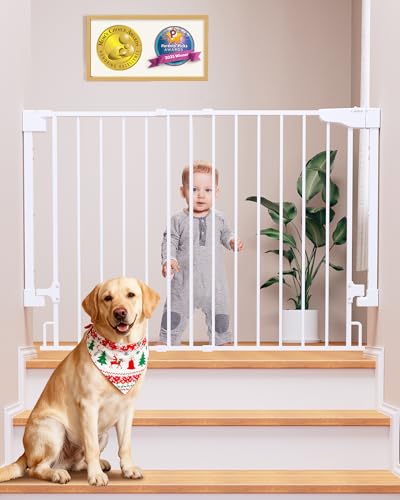
Last update on 2026-08-19 / Affiliate links / Images from Amazon Product Advertising API
Cumbor’s own product listing states the exact safety principle covered above directly: hardware mounting is essential for the top of stairs. No bottom bar removes the tripping hazard right at the spot where a trip could actually cause a fall.
- Mount typeHardware (drilling required)
- Width29.2–43″
- Bottom barNone
- Best ForTop of stairs specifically
What’s Inside!
- 1 – What Actually Matters When Choosing a Stair Gate
- 2 – Stair Gate Comparison Table
- 3 – Stair Gate Reviews, by Mount Type and Use Case
- 3.1 – 1. Cumbor (Best for Stair Tops)
- 3.2 – 2. Babelio (Best All-Steel Construction)
- 3.3 – 3. Toddleroo Supergate Ergo (Best Flexible Mount Option)
- 3.4 – 4. COMOMY (Best for Doorways and Bottom of Stairs)
- 3.5 – 5. PRObebi (Best for Wide or Irregular Openings)
- 3.6 – 6. InnoTruth (Best for Round Banisters)
- 4 – Which Stair Gate Should You Buy?
- 5 – Stair Gate FAQ
- 6 – Final Thoughts
What Actually Matters When Choosing a Stair Gate
Mount type, first and always. As covered above, this is the one factor that actually determines whether a gate belongs at the top of your stairs. Check the listing explicitly — “pressure mounted” and “hardware mounted” are not interchangeable, regardless of how sturdy a pressure-mount gate feels when you push on it in the store.
No bottom bar for stair-top gates. A threshold bar sitting right at the top of a staircase is a real tripping hazard exactly where a trip is most dangerous. Gates specifically marketed as “no bottom bar” or with a low-profile threshold are worth prioritizing for that location.
Height and slat spacing. ASTM F1004 requires a minimum 22-inch height and caps slat gaps at 2 3/8 inches to prevent a dog or child from squeezing through. For a jumper or larger dog, look beyond the minimum — extra-tall options (36-42″) give real margin.
Latch design. A latch requiring two deliberate steps to open (per the federal standard) keeps a clever dog from figuring it out through repeated pawing, while still staying fast for a person to operate one-handed.
Material and construction. All-metal construction holds up best to a large or determined dog leaning or pushing against it repeatedly. Plastic and wood options are lighter and fine for smaller, calmer dogs, but won’t take the same abuse.
Stair Gate Comparison Table





Last update on 2026-08-19 / Affiliate links / Images from Amazon Product Advertising API
Stair Gate Reviews, by Mount Type and Use Case
1. Cumbor (Best for Stair Tops)
Best for Stair Tops
Last update on 2026-08-19 / Affiliate links / Images from Amazon Product Advertising API
- Mount typeHardware (drilling required)
- Width29.2–43″
- Bottom barNone
- Best ForTop of stairs specifically
This gate is built specifically for the highest-risk location in the house, and it doesn’t hedge about it — the listing states plainly that hardware mounting is essential for stair-top safety, matching the federal standard exactly rather than leaving buyers to guess.
The no-bottom-bar design opens the full width for a clean walk-through, removing the exact tripping hazard that makes bottom-bar gates a poor fit for this location. Auto-close and a dual-lock system add real, everyday convenience without compromising the hardware-mount security.
Installation requires drilling, which is the real tradeoff for the added security — not a fit for renters or anyone wanting a no-tools setup.
Pros
- Explicitly built and marketed for stair-top safety
- No bottom bar removes the tripping hazard
- Auto-close, dual-lock convenience
Cons
- Requires drilling — not ideal for renters
2. Babelio (Best All-Steel Construction)
Best All-Steel Construction
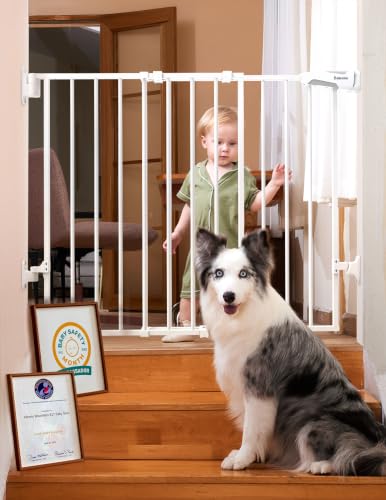
Last update on 2026-08-19 / Affiliate links / Images from Amazon Product Advertising API
- Mount typeHardware (drilling required)
- Width26–43″
- Bottom barNone
- Best ForLarger, stronger dogs
Babelio’s all-steel construction and sill-free design match Cumbor’s stair-top-appropriate profile, with real durability that holds up to a bigger or more determined dog leaning against it repeatedly.
One-handed operation stays practical even with the added structural weight of full steel, and the wide walk-through door makes daily use noticeably easy rather than a chore.
Like any hardware-mount gate, expect a real installation process — this isn’t a five-minute, tools-free setup.
Pros
- All-steel construction, built for larger dogs
- No bottom bar, sill-free design
- Wide walk-through door
Cons
- Real installation effort, drilling required
3. Toddleroo Supergate Ergo (Best Flexible Mount Option)
Best Flexible Mount Option
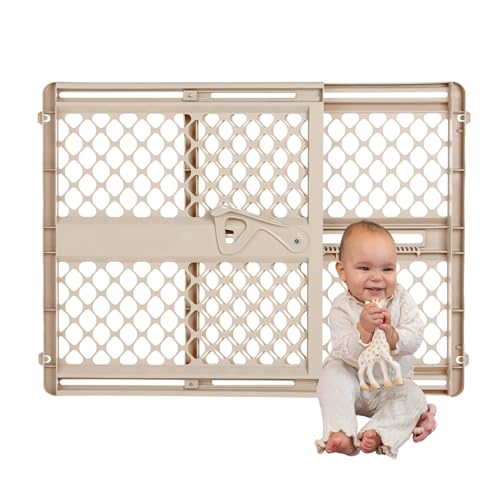
Last update on 2026-08-19 / Affiliate links / Images from Amazon Product Advertising API
- Mount typePressure or hardware (included)
- Width26–42″
- Height26″
- Best ForHouseholds wanting one gate for multiple locations
The real advantage here is real flexibility — one gate, two legitimate installation options, so the correct choice depends on where you’re placing it rather than which product you bought. Use hardware mount for the stair top, pressure mount for a doorway elsewhere in the house.
Made in the USA, and the wall cups included for pressure mounting protect your walls better than bare tension pads. It’s a reasonably priced entry point if you need gates for more than one location and don’t want to buy two different products.
At 26 inches, it’s on the shorter end — worth checking against a jumper or larger dog’s actual height before relying on it as a stair-top barrier.
Pros
- Dual mount-type flexibility in one product
- Made in the USA, wall cups included
- Good value if you need multiple locations covered
Cons
- 26″ height may not contain a jumper or larger dog
4. COMOMY (Best for Doorways and Bottom of Stairs)
Best for Doorways and Bottom of Stairs
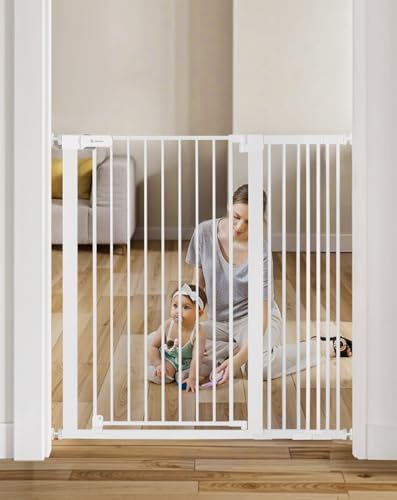
Last update on 2026-08-19 / Affiliate links / Images from Amazon Product Advertising API
- Mount typePressure mount
- Width29.5–43.3″
- Height42″
- Best ForJumpers, doorways, bottom of stairs
This is an honest pick specifically because it doesn’t oversell itself — the listing states directly that hardware mounting is essential if used at the top of stairs, and positions this pressure-mount gate for doorways and bottom-of-stairs use instead, exactly matching the buyer’s guide above.
The real standout is height: 42 inches, tall enough to stop a serious jumper that a standard 30-inch gate wouldn’t contain. Tool-free installation makes it fast to set up wherever pressure mount is the right call.
As with any pressure-mount gate, this isn’t the pick for a stair top — use it for the locations it’s actually built for.
Pros
- Honest about where it should and shouldn’t be used
- Real 42″ height stops serious jumpers
- Tool-free installation
Cons
- Not rated for stair-top use — pressure mount only
5. PRObebi (Best for Wide or Irregular Openings)
Best for Wide or Irregular Openings

Last update on 2026-08-19 / Affiliate links / Images from Amazon Product Advertising API
- Mount typeHardware (drilling required)
- WidthUp to 54″
- Height34″
- Best ForWide, angled, or irregular openings
A retractable mesh design solves a real problem swing-door gates struggle with — wide, angled, or unusually shaped openings where a rigid panel doesn’t fit cleanly. It extends up to 54 inches and retracts flat against the wall when not in use.
Hardware-mounted, which matters here specifically since it’s real load-bearing mesh rather than a solid panel — the anchoring needs to be secure. A real, well-selling product, not a niche specialty item.
Mesh isn’t as rigid as a metal swing gate, and won’t take the same repeated leaning force from a large, determined dog.
Pros
- Solves wide or irregular openings a swing gate can’t
- Hardware-mounted for real security
- Retracts flat when not needed
Cons
- Mesh won’t withstand repeated force like a metal panel
6. InnoTruth (Best for Round Banisters)
Best for Round Banisters
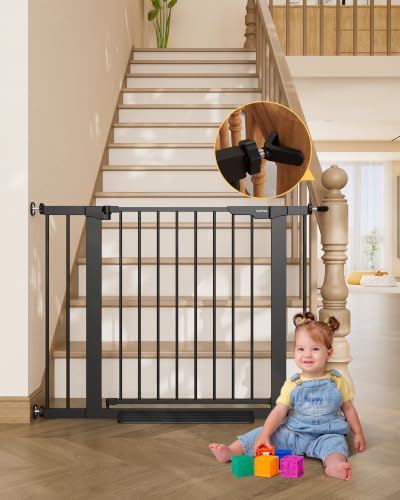
Last update on 2026-08-19 / Affiliate links / Images from Amazon Product Advertising API
- Mount typePressure or hardware
- Width29.6–39.1″
- ExtrasY-bolts for round banisters
- Best ForRound or ornate stair banisters
The real, specific differentiator here is the included Y-bolts, designed for round stair banisters that standard flat mounting hardware doesn’t grip well — a real, practical answer to a common installation headache other gates don’t address.
Like the Toddleroo pick, it offers both mount types, with the listing directly recommending hardware mounting for “high-traffic areas such as stairs” — consistent, correct guidance rather than leaving the choice unexplained. Double-lock design and two-way swing add real everyday practicality.
The narrower width range (29.6–39.1″) means it’s a better fit for standard openings than unusually wide staircases.
Pros
- Real Y-bolts specifically for round banisters
- Correct, explicit hardware-mount guidance for stairs
- Double-lock, two-way swing
Cons
- Narrower width range than some competitors
Which Stair Gate Should You Buy?
| Situation | Pick |
|---|---|
| Not sure where to start | Cumbor |
| Larger or stronger dog | Babelio |
| Need one gate for multiple locations | Toddleroo Supergate Ergo |
| Doorway or bottom of stairs, serious jumper | COMOMY |
| Wide, angled, or irregular opening | PRObebi |
| Round or ornate stair banister | InnoTruth |
Stair Gate FAQ
Is a pressure-mount gate actually unsafe at the top of stairs?
Yes, this is a real safety issue, not overcaution. ASTM F1004, the mandatory federal safety standard for these gates, states that hardware-mounted gates are the only safe choice at the top of stairs specifically. Pressure-mount gates rely on friction and can be dislodged by a strong push, which is a real fall risk at a stair top. They’re perfectly fine for doorways, room dividers, or the bottom of stairs.
How tall should a stair gate be for a dog that jumps?
The federal minimum is 22 inches, but that’s a floor, not a real ceiling for a jumper. For dogs known to jump, look at extra-tall options in the 36-42 inch range rather than assuming any gate labeled “stair gate” will contain them.
Why does a bottom bar matter for stairs specifically?
A threshold bar sitting right at the top of a staircase creates a real tripping hazard at exactly the spot where a trip is most dangerous. Gates marketed as “no bottom bar” remove this specific risk, which matters more at a stair top than in a regular doorway.
Can I use the same gate at both a doorway and the top of my stairs?
Only if it’s rated for both — check the specific listing rather than assuming. Some gates, like dual-mount options, do support pressure mounting in one location and hardware mounting in another. A pressure-mount-only gate should not be moved to a stair top regardless of how sturdy it feels.
Final Thoughts
Mount type matters more than any other spec on this list — check it explicitly before buying, and never use a pressure-mount-only gate at the top of stairs regardless of price or reviews. From there, match height and bottom-bar design to your specific dog’s size and jumping ability, and pick hardware mount whenever the location allows for it.