
Rebuilt with veterinary sourcing on senior incontinence and 5 verified current picks
It’s easy to assume a senior dog having more accidents is just old age catching up. Sometimes it is. But Dr. Jamie Richardson, head of veterinary medicine at Small Door Vet, notes that sudden-onset incontinence specifically “usually indicates an acute, underlying health issue like a urinary tract infection or even diabetes.” One veterinary-content source puts it more bluntly: “urinary incontinence in older dogs is never normal… this is a myth we must dispel.” If the accidents are new or getting worse, a vet visit before settling into a pad routine is worth it — some causes have a real fix, not just a workaround.
That said, plenty of senior dogs do need ongoing help once an underlying cause is identified and managed, whether from muscle weakness, arthritis making it hard to get up in time, or cognitive changes that come with age. For those situations, the right pad matters more than most guides let on — not just for absorbency, but for keeping your dog safely on their feet. Below, we cover what actually matters, plus 5 current picks, each solving a different problem.
Editor’s Pick

Last update on 2026-08-19 / Affiliate links / Images from Amazon Product Advertising API
What’s Inside!
What Actually Causes Senior Incontinence
A few specific causes cover most cases. USMI (urethral sphincter mechanism incompetence) is the single most common cause in senior dogs, frequently linked to reduced estrogen in spayed females, and it’s treatable with medication in most cases. UTIs are common and usually resolve fully with antibiotics. Diabetes, Cushing’s disease, and kidney disease all cause excessive drinking and urination that can look like incontinence, and managing the underlying condition typically reduces or resolves it. Arthritis and mobility issues can make it physically painful for a dog to get into position to urinate outside in time. Cognitive decline in senior dogs — sometimes described as the canine version of dementia — can mean a dog truly forgets housetraining rather than losing physical control.
A wet spot where your dog was sleeping or resting is a classic, specific sign worth mentioning to your vet directly. It usually means the muscles controlling urine flow relax during deep rest, which points toward a muscle-tone or hormonal cause rather than a behavioral one. Left unmanaged, constant urine contact with skin can also cause a painful condition called urine scald — a practical reason pad absorbency and change frequency matter beyond just floor protection.
Genuinely built for incontinence management specifically, not a repurposed puppy pad — rated for up to 500 wash cycles, with real demand confirmed independently across two Amazon Best Sellers categories.
What to Actually Look For in a Pad
Non-slip backing. An underdiscussed factor for older dogs specifically — arthritis or reduced coordination makes a slippery pad a genuine fall risk, not just an inconvenience. This matters more here than in a standard puppy-training-pad guide.
Absorbent capacity. Higher is better, and specific numbers (cups or milliliters held) are more useful than vague “super absorbent” marketing language. A dog resting for hours needs a pad that won’t reach capacity and let urine reach skin or bedding underneath.
Leak-proof edges. A waterproof bottom layer alone isn’t enough — reinforced or raised edges matter specifically for a resting or sleeping dog who isn’t actively positioning over the pad the way a dog using it for a quick potty break would.
Washable vs. disposable. Washable pads cost more upfront but pay off for ongoing, long-term management. Disposable pads are more practical for travel or occasional use. Neither is universally “better” — it depends on how often and how long you’ll actually need one.
Pee Pad Comparison Table


Last update on 2026-08-19 / Affiliate links / Images from Amazon Product Advertising API
Pee Pad Reviews
1. AmazonBasics (Best Value Disposable)
Best Value Disposable

Last update on 2026-08-19 / Affiliate links / Images from Amazon Product Advertising API
- TypeDisposable, 5-layer
- Size22″ x 22″
- Best ForStraightforward, cost-effective everyday use
A current bestseller in this category on Amazon’s own rankings, not just a claim. The 5-layer construction turns liquid to gel on contact, and a plastic border on all four sides contains overflow — checkable construction detail rather than vague marketing language.
Available in bulk counts, which matters for ongoing daily use rather than occasional need. It’s straightforward, no frills — a solid default rather than a specialty pick for a particular problem like mobility safety or bedding protection.
Standard disposable pads like this one don’t include non-slip backing — worth pairing with a rubber mat underneath if your dog has mobility concerns and this is the pad you choose.
Pros
- Confirmed bestseller status
- Genuine 5-layer construction with checkable leak-proof design
- Cost-effective in bulk
Cons
- No non-slip backing — pair with a mat if mobility is a concern
2. Green Lifestyle Washable Underpads (Best for Incontinence)
Best for Incontinence
Last update on 2026-08-19 / Affiliate links / Images from Amazon Product Advertising API
- TypeWashable, medical-grade “chucks” design
- Size30″ x 34″
- Best ForOngoing bedding protection during rest
This is built around incontinence management specifically, not a puppy training pad repurposed for a different job. The listing describes it directly as built for “adults and seniors with incontinence,” and it appears independently in two separate Amazon Best Sellers categories — a genuine signal of actual demand, not just its own marketing.
Quilted, waterproof-backed construction rated for up to 500 wash cycles on this product line makes it a solid long-term option for daily use rather than something you’ll replace within months. It fits standard mattress and bedding sizes, useful if your dog sleeps on a bed or in a specific resting spot regularly.
It’s priced for the ongoing-use case it’s built for — worth weighing if your dog’s need turns out to be occasional rather than daily.
Pros
- Built for incontinence specifically, not a repurposed training pad
- Rated for up to 500 wash cycles
- Independently confirmed demand across two bestseller categories
Cons
- Priced for ongoing use — less economical for occasional need
3. Green Lifestyle Anti-Slip (Best for Mobility Safety)
Best for Mobility Safety

Last update on 2026-08-19 / Affiliate links / Images from Amazon Product Advertising API
- TypeWashable, anti-slip backing
- Size34″ x 36″
- Best ForDogs with arthritis or reduced coordination
A different product from the underpad above, built specifically around anti-slip and anti-tracking technology — the differentiator that matters directly for the mobility-safety concern this article’s buyer’s guide raises. A pad that shifts or slides underfoot is a real fall risk for a dog with arthritis or reduced coordination, not just an inconvenience.
The anti-tracking design also keeps mess from spreading across the floor after use, a practical secondary benefit alongside the safety one. Machine washable for ongoing use.
It’s lighter-duty than the dedicated incontinence underpad above — a better fit for a dog with mobility concerns but lighter or less frequent accidents than one needing maximum absorbent capacity.
Pros
- Real anti-slip backing directly addresses fall risk
- Anti-tracking design limits mess spread
- Machine washable
Cons
- Lighter-duty than dedicated high-capacity incontinence pads
4. OUT! Petcare (Best Large-Capacity Disposable)
Best Large-Capacity Disposable

Last update on 2026-08-19 / Affiliate links / Images from Amazon Product Advertising API
- TypeDisposable, heavy duty
- Size26″ x 30″
- Best ForLarger dogs, heavier accidents
Explicitly marketed for senior dog incontinence specifically, not just puppy training — and the sales data backs up the claim, with an independent tracking estimate around 50,000 units sold monthly and a genuine 4.3-star rating across roughly 15,000 reviews.
Heavy-duty, leak-proof construction holds up to genuinely larger volume than a standard disposable pad, which matters for a bigger dog or a dog with more significant incontinence rather than occasional light accidents.
Like most disposables, it lacks the anti-slip backing the washable picks above offer — a real tradeoff if mobility safety matters more than capacity rather than capacity.
Pros
- Explicitly marketed and reviewed for senior incontinence specifically
- Real, independently-tracked sales volume and rating
- Genuine heavy-duty capacity for larger dogs
Cons
- No non-slip backing
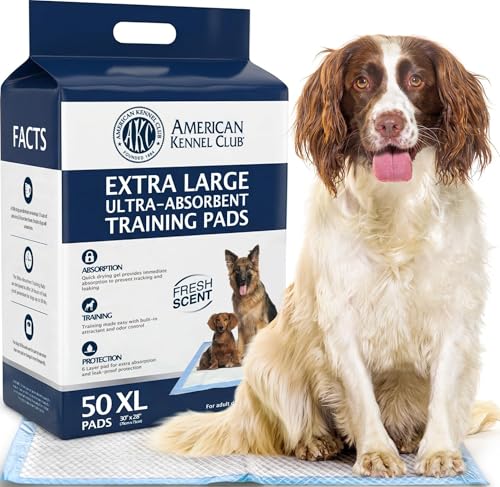
5. American Kennel Club (Best Established Brand)
Best Established Brand
Last update on 2026-08-19 / Affiliate links / Images from Amazon Product Advertising API
- TypeDisposable
- Size28″ x 30″
- Best ForBuyers who want a recognized, established name
The differentiator here is brand recognition backed by an actual organization, not just a licensed logo on generic packaging — the American Kennel Club has real, longstanding authority in the dog world specifically.
Ultra-absorbent quick-dry gel technology and XL sizing cover the practical basics well, and it’s available scented or unscented depending on preference.
It doesn’t offer a specific senior-incontinence angle the way the OUT! or Green Lifestyle picks do — a solid, general-purpose option rather than one built around this article’s specific use case.
Pros
- Genuine, established brand authority
- Real quick-dry gel technology
- Available scented or unscented
Cons
- No specific senior-incontinence design angle
Which Pee Pad Should You Buy?
| Situation | Pick |
|---|---|
| Not sure where to start | AmazonBasics |
| Ongoing incontinence management | Green Lifestyle Washable Underpads |
| Dog has arthritis or mobility issues | Green Lifestyle Anti-Slip |
| Larger dog, heavier accidents | OUT! Petcare |
| Want a recognized, established brand | American Kennel Club |
Pee Pads for Older Dogs FAQ
Is incontinence just a normal part of a dog getting old?
Not automatically. Veterinary sources are direct about this — new or worsening incontinence usually signals an underlying, often treatable cause: a UTI, diabetes, kidney disease, or reduced hormone levels after spaying. See your vet before assuming it’s just aging, especially if the accidents are new or getting worse rather than a long-standing, already-diagnosed condition.
Why does my dog leak urine specifically while sleeping?
This is a specific sign worth mentioning to your vet directly. It typically means the muscles controlling urine flow relax during deep rest, pointing toward a muscle-tone or hormonal cause (like USMI, common in spayed females) rather than a behavioral issue.
Should I choose washable or disposable pads?
Depends on frequency and duration. Washable pads cost more upfront but are more economical for ongoing, long-term daily management. Disposable pads are more practical for travel, occasional use, or while you’re still working out the underlying cause with your vet.
Why does non-slip backing matter specifically for older dogs?
A slippery pad is a genuine fall risk for a dog with arthritis or reduced coordination, not just an inconvenience. This matters more for senior dogs specifically than for puppy training, where the dog is typically more mobile and stable.
Final Thoughts
Don’t skip the vet visit if the incontinence is new — some of the most common causes are actually treatable, not just something to manage indefinitely with pads. Once you know what you’re actually dealing with, match the pad to the actual need: non-slip backing for mobility safety, a proper incontinence-grade design for ongoing daily use, or a straightforward disposable pad for lighter or occasional need.
Thanks for this useful and informative article, I really like the table that made my decision easier.