Rebuilt with blunt, real-review-sourced findings and 5 verified current picks
Some dogs shrug off bitter apple entirely. That’s a documented minority, not a sign you’re using it wrong. If a full week of consistent application does nothing, don’t reach for a stronger dose of the same thing. Switch mechanisms — sour-plus-bitter instead of bitter alone. One more distinction to know before buying: most of these sprays are surface-only. They explicitly aren’t meant for skin contact. A smaller category is formulated safe for a dog licking a hot spot or wound, and that’s a different product, not just a different scent.
Below: what to check before buying, plus 5 current picks, with whatever the actual reviews turned up — good or bad.
Editor’s Pick

Last update on 2026-08-19 / Affiliate links / Images from Amazon Product Advertising API
The original, most established name in the category, with a genuine 66-year history. Reliable on hard surfaces, though not the pick for fabric or skin — see the alcohol-free options below for that.
What’s Inside!
Why Dogs Chew

Chewing itself isn’t a bad habit. It cleans a dog’s teeth, and for puppies, it’s just how they explore the world. It becomes a problem once it’s aimed at furniture, shoes, or anything else you’d rather keep intact. Three causes cover most cases:
Boredom. A dog without enough mental or physical stimulation will find something to occupy itself, and chewing is one of the easiest options available. Chew toys or bones help, and so does dog-friendly music if your dog is home alone for long stretches.
Teething. This peaks during a puppy’s tooth development. A spray alone won’t fix it — pair it with appropriate chew toys so the puppy has a legitimate outlet while the spray protects everything else.
Separation anxiety. A dog that chews specifically when left alone may be anxious rather than bored. Training toward comfortable alone-time and calming music both help. In persistent cases, talk to your vet about the anxiety itself — that will do more than a spray ever will on its own.
What to Actually Check Before Buying

Alcohol content matters more than most labels make obvious. Alcohol-free formulas are gentler and safer for repeated use, including directly on skin when the product allows it. Alcohol-based sprays — Grannick’s original formula included — can sting broken skin or irritated hot spots, and may leave marks on fabric.
Mechanism is the other variable. Straight bitter-apple works for most dogs, but a minority simply don’t respond to it. If that’s your dog after a fair trial, try a sour-plus-bitter combination before assuming no spray will ever work.
Skin-safe and surface-only are not the same category. If your dog is licking or chewing a hot spot, wound, or bandage rather than furniture, check that the product is labeled safe for direct skin application. Most anti-chew sprays are formulated for surfaces only and explicitly warn against this use. Persistent licking of one specific spot is also worth a vet visit on its own — it can signal allergies or an underlying skin issue a spray won’t resolve.
No Chew Spray Comparison Table


Last update on 2026-08-19 / Affiliate links / Images from Amazon Product Advertising API
No Chew Spray Reviews, by Mechanism and Use Case
1. Grannick’s Bitter Apple (Best Overall)
Best Overall
Last update on 2026-08-19 / Affiliate links / Images from Amazon Product Advertising API
- MechanismBitter
- AlcoholContains isopropanol
- Best ForHard surfaces, established reliability
A pharmacist named Irv Grannick first mixed this formula in 1960 for a nervous show dog that wouldn’t stop licking its coat. The product line built on that recipe is still, by most accounts, the most recognized name in the category.
Reviews are mixed here, not uniformly glowing. One detailed account describes a dog who, deterred from chewing the front of a rug, simply turned it over and chewed through the back — a 3.5-inch hole, plus three smaller ones. Other owners report their dog stopped a chewing habit within minutes of the first spray. Both outcomes are documented, not cherry-picked.
One safety detail worth stating plainly: multiple vet-consult reports describe dogs getting eye irritation from accidental spray contact, and at least one account of a dog drinking it directly and vomiting. Avoid the eyes and mouth. Test fabric for colorfastness first — spray a hidden spot, wait an hour, check. And since the ingredient list includes isopropanol, skip fabric and upholstery entirely. Hard surfaces like wood trim and baseboards are the safer application.
Pros
- The original, most established name in the category
- Many owners report fast, effective results
- Widely available in multiple sizes
Cons
- Documented cases of persistent dogs working around it — chewing from a different angle
- Contains alcohol; can stain fabric and has caused eye irritation in some reported cases
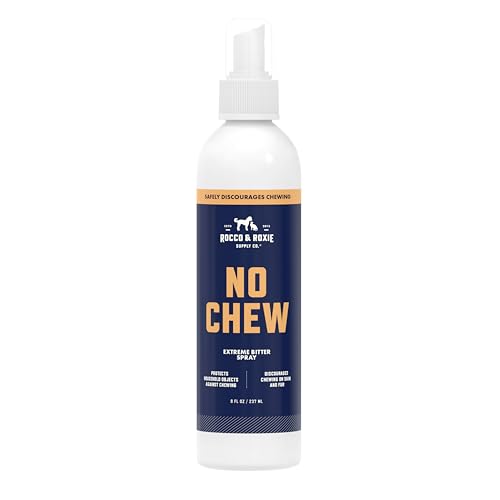
2. Rocco & Roxie (Best Alcohol-Free, Skin-Safe)
Best Alcohol-Free, Skin-Safe
Last update on 2026-08-19 / Affiliate links / Images from Amazon Product Advertising API
- MechanismBitter, with copaiba oil
- AlcoholAlcohol-free
- Best ForFabric, furniture, and direct skin use
Copaiba oil is the differentiator here. It has a documented calming, soothing effect on skin. Useful if part of your spraying targets a dog licking itself rather than just furniture. Alcohol-free means it’s safe for that direct use in the first place.
A number worth knowing before you buy: an independent analysis of 1,124 verified reviews found 57% negative sentiment against 31% positive. That’s majority-negative, not the unambiguous win most roundups suggest. One detailed account: it didn’t work as a standalone fix for a determined Bichon puppy, but worked better paired with bully sticks — the spray made the forbidden item less appealing while the sticks gave a legitimate alternative.
The scent is milder than some bitter formulas, and the taste still lands for many dogs. It costs a bit more than the basic bitter-apple originals. Given the sentiment split, treat this as one piece of a chewing plan, not a standalone fix.
Pros
- Alcohol-free, safe for direct skin use
- Copaiba oil adds real soothing benefit
- Works well as part of a combined approach with redirect toys
Cons
- Independent review data skews majority-negative — 57% negative in a 1,124-review analysis, not a guaranteed standalone fix
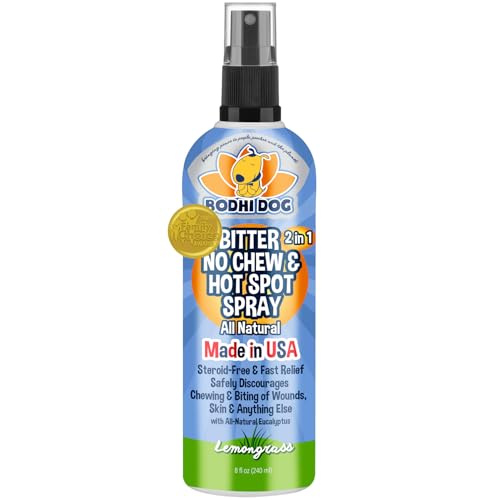
3. Bodhi Dog 2-in-1 (Best for Hot Spots)
Best for Hot Spots
Last update on 2026-08-19 / Affiliate links / Images from Amazon Product Advertising API
- MechanismBitter, dual-purpose
- AlcoholAlcohol-free
- Best ForLicking, hot spots, wounds
A small, family-owned business in Austin partners with a named professional trainer, Sam Hoke of Ranch Dog Training, on how the product is used. The formula has won the Family Choice Award twice — a real, checkable award, unlike the company’s own claim of “2.5 million customers and 80,000+ five-star reviews,” which is manufacturer-reported and not independently verified anywhere I could confirm.
Results are mixed by dog. One owner reports zero effect on a Doberman and a Pit Bull’s shared habit of chewing door trim. Another describes a puppy that stopped touching kitchen chairs immediately after the first spray. One recurring complaint: the spray pump itself failing after just a few uses on at least one unit.
For hot spots and skin-licking, application technique matters. Reviewers who got relief applied it directly to the irritated skin, not just the surrounding fur. Persistent licking at one spot is still worth a vet visit on its own.
Pros
- Genuinely dual-purpose — deterrent and hot-spot soother
- Small business, US-sourced ingredients
- Works across surfaces and skin
Cons
- Won’t address an underlying skin condition on its own
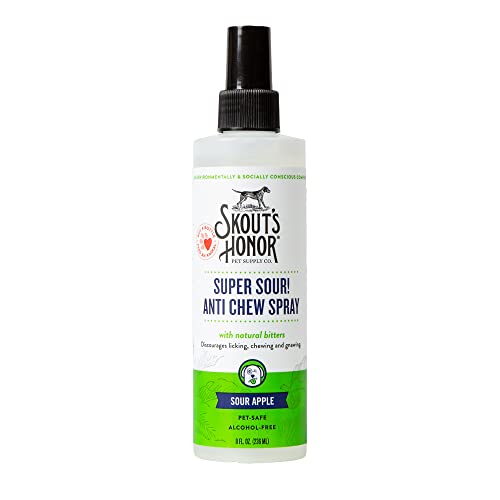
4. Skout’s Honor Super Sour (Worth Testing First)
Worth Testing First
Last update on 2026-08-19 / Affiliate links / Images from Amazon Product Advertising API
- MechanismSour + bitter combination
- AlcoholAlcohol-free
- Best ForA different mechanism worth trying — caveat below
Sour apple bitters plus malic acid and sodium bicarbonate create a different taste profile than plain bitter apple. That mechanism is the actual reason it’s included here — not a confident performance claim.
Multiple independent reviews report the opposite of the intended effect. One Chewy reviewer describes a dog chewing the bottle itself until it had several holes. A Petco reviewer says their dogs were “actually attracted to whatever I sprayed… chewed up more of the chairs and countless wires/cables.” A separate review-aggregation analysis found enough of this pattern to recommend Grannick’s Bitter Apple instead. This isn’t one bad review. It’s a repeated, independently-reported failure mode.
Test it on one small item first before spraying your whole house. The sour-apple flavor profile appeals to some dogs instead of repelling them, and there’s no way to know in advance which category yours falls into.
Pros
- Genuinely different mechanism from plain bitter apple
- Alcohol-free, works across multiple surface types
- Charitable Paw Pledge program with every purchase
Cons
- Multiple independent reports of dogs finding the taste appealing rather than repellent — test on a small area first
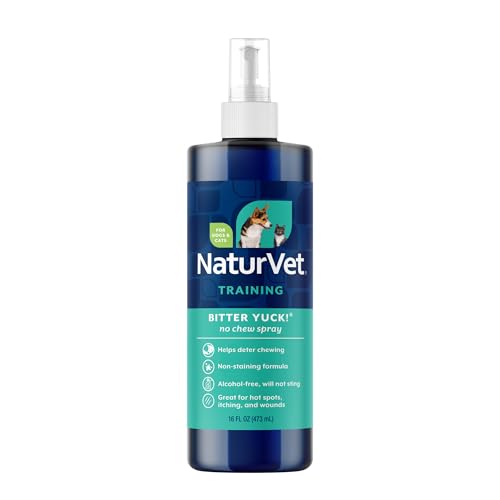
5. NaturVet Bitter Yuck! (Best Vet-Formulated)
Best Vet-Formulated
Last update on 2026-08-19 / Affiliate links / Images from Amazon Product Advertising API
- MechanismBitter
- AlcoholAlcohol-free
- Best ForPuppies, cautious first-time users
Manufactured in an FDA-audited, cGMP-compliant US facility with veterinarian involvement in the formulation — checkable, not a vague “vet recommended” claim with nothing behind it.
Cross-species safe for cats and horses too, a real plus in a mixed-pet household needing one product instead of several. Trainers commonly point to this one for puppies specifically, given the gentler, more cautious formulation.
It’s a straightforward bitter formula, no secondary mechanism. A solid default. Not a specialty pick for a specific problem.
Pros
- Verified vet-formulated credibility, FDA-audited facility
- Cross-species safe for mixed-pet households
- Commonly recommended for puppies specifically
Cons
- Standard bitter mechanism, no specialty differentiation
Which No Chew Spray Should You Buy?
| Situation | Pick |
|---|---|
| Not sure where to start | Grannick’s Bitter Apple |
| Fabric, furniture, or direct skin use | Rocco & Roxie |
| Dog licking a hot spot or wound | Bodhi Dog 2-in-1 |
| Bitter apple hasn’t worked, want a different mechanism to try | Skout’s Honor Super Sour |
| Puppies, mixed-pet households | NaturVet Bitter Yuck! |
No Chew Spray FAQ
My dog doesn’t react to bitter apple at all — now what?
Some dogs simply aren’t deterred by bitter apple, regardless of brand or reapplication frequency — a documented minority, not a training failure. After a full week of consistent use with no change, switch mechanisms. A sour-plus-bitter combination works for many dogs the standard bitter approach misses.
Does vinegar or lemon juice work as a DIY alternative?
Both have some effect, generally milder and less consistent than a purpose-made spray. Two parts apple cider vinegar to one part white vinegar in a spray bottle is a reasonable stopgap. Undiluted lemon juice wiped directly on a surface works similarly for dogs that respond to citrus.
Is it safe to spray this directly on my dog?
Only if the specific product is labeled for skin use. Most anti-chew sprays are surface-only and explicitly warn against direct application. If your dog is licking a hot spot or wound rather than chewing furniture, look for a product formulated safe for skin, and see a vet if the licking is persistent and localized to one area.
Will a muzzle stop my dog from chewing?
It can prevent chewing in the moment, but it doesn’t address why your dog chews — boredom, teething, or anxiety. Treat it as a short-term management tool during training, not a standalone fix.
Final Thoughts
Match the spray to the actual cause and the actual surface. Hard surfaces can take an alcohol-based formula. Fabric and skin need alcohol-free. A true non-responder needs a different mechanism, not more of the same spray. Pair whichever you choose with real chew toys. If separation anxiety is the underlying cause, address that directly — a spray alone won’t solve it.



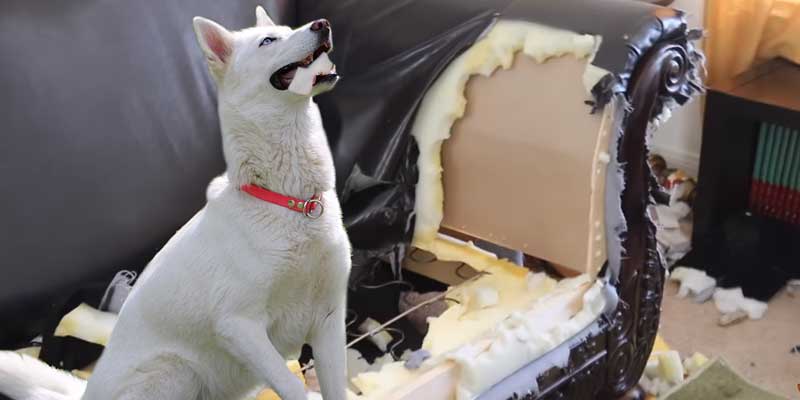
OMG, my new expensive sofas are gone I wish I knew it earlier that there are anti-chew products available. Just regretting now, because I have tested some of these and they are working just fine.